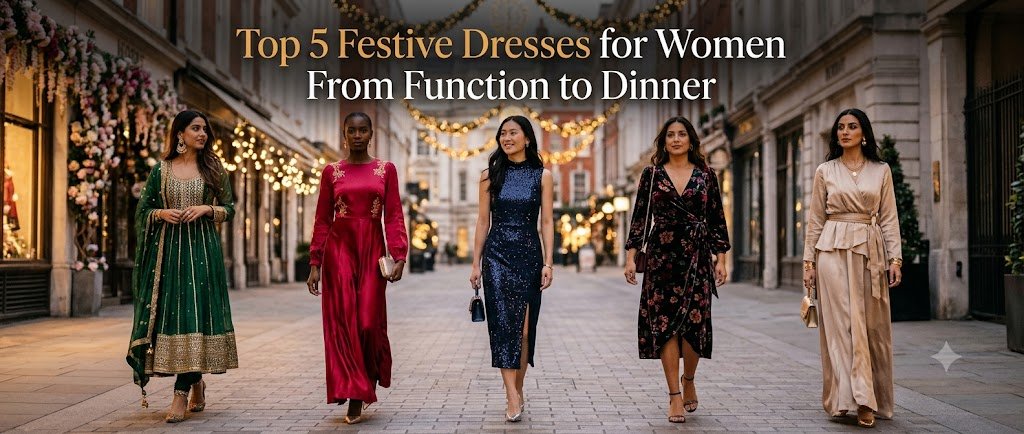
Choosing a festive outfit is really three decisions at once: what time the event starts, where it is and how formal it is, and how you want to feel in what you are wearing. A daytime function asks for something different from a long dinner that runs late, and travel changes the answer again. The five directions below mix traditional and contemporary options. Do not treat any single one as the rule for every function — pick according to your taste, the dress code and the weather.
1. Anarkali or long kurta set
An anarkali-style suit or a long kurta with trousers or leggings gives you a festive silhouette that can stretch through to dinner afterwards. Look at the flare, the sleeve and the neckline against how much you will be moving and where you are going. If the outfit is heavily embellished, test it sitting down, on stairs and in a car — those three are where most of the discomfort shows up. Plan the dupatta pinning or drape before the day, not in the car.
Solid jewel tones or a subtle print dress up nicely with accessories; colour also depends on the season, your cultural preference and what you actually like. Check the lining, the transparency and the care label. If you will be wearing it through dinner, consider a light layer or a breathable construction depending on the fabric weight and the temperature.
2. Saree or easy-drape option
A saree is a flexible choice for formal and festive occasions, but the drape, the blouse fit and the length of the event are worth planning in advance. Verify the saree length, how the fabric falls, whether a blouse is included and the lining details. Ready-to-wear or pre-stitched versions are an option too; test the closure and the fit while you move.
If you are going from the function to dinner, pay attention to your footwear and to how stable the drape is. Walking and sitting in it before the event cuts down on last-minute fixes. Balance the accessories against the weight and comfort of the outfit. If you are wearing heavy jewellery, do not overcrowd the neckline and the blouse detail — simple coordination can look just as polished.
3. Lehenga set or skirt-and-top
A lehenga, a skirt-and-top or a coordinated festive set works for dancing, photographs and family events. Check the waist closure, the skirt length, the lining and the blouse fit. Test the hem with your shoes so there is no tripping risk when you walk. Whether the skirt's weight and flare are manageable for a long event is something you will only know by putting it on.
Think about whether the pieces can be worn separately while you are still shopping. If the blouse works with a plain saree, or the skirt with a simple top, your repeat-wear options grow. Understand the care instructions and the storage requirements for the embellishments. Keep your budget and your future occasions in mind so it does not become a one-time-only purchase.
4. Sharara, palazzo or festive co-ord
A sharara or palazzo set gives you a festive look in a more movement-friendly shape — provided the fit and the fabric are comfortable for you. Check the length of the top, the lower and the dupatta separately. Test practically whether wide lower wear is manageable on stairs or in a crowded venue. Look at the elastic or zip closure and at how it feels when you sit.
A coordinated set can be reworked for different events with earrings, a clutch or a change in dupatta styling. Keeping the accessories simple with printed or embellished pieces is one approach; there is no fixed rule. The fabric should feel comfortable enough to wear through dinner. Confirm on the product page which pieces are included and what the actual colour looks like.
5. Fusion dress or long jacket look
A fusion option might mean a long jacket with trousers, a cape-style layer, a kurta-dress or a contemporary gown-type silhouette. Choose it when the venue and the dress code suit it. Check the layer by moving your arms, sitting in a chair and walking. The sleeve opening, the closure and the garment length should all be practical during dinner.
Pick one focal element in a fusion outfit — the print, the jacket, the neckline or the jewellery — so the look stays comfortable and balanced. Choose shoes for the location: an outdoor lawn, stairs or a long standing event all change how much heel and how much stability you want. To get more wear out of a festive outfit, match the jacket or the accessories with other outfits.
Planning an outfit from the function through to dinner
Check the invitation for the dress code, the start time and the venue. Choose your layer with the travel and the venue temperature in mind. Safety pins or a small repair kit in your bag is a reasonable habit, but testing the closures beforehand is more useful. Try the makeup, the jewellery and the footwear on together with the garment — an outfit can look quite different on a hanger than it does on you.
Hypothetical example: a family function starts in the afternoon and runs through to dinner. You pick a comfortable kurta set, drape the dupatta in a secure style, and add earrings or a light jacket for the evening. That is an example; the dress code, the weather and individual comfort will all vary.
Festive shopping checklist
- I have checked the dress code, venue, weather and duration on the invitation.
- I have tested walking, sitting, stairs and arm movement in the outfit.
- Confirmed whether the blouse, lining, dupatta, belt and accessories are included.
- Footwear matched to the venue and to long wear.
- Care, storage and alteration needs understood.
- I have a plan for rewearing it at future events or as separates.
Common mistakes
- Choosing an outfit for the photos: test the actual comfort and the movement the event requires.
- Ignoring the dress code: choose the level of formality according to the venue and the host's guidance.
- Leaving accessories to the last minute: coordinate the footwear, blouse and dupatta in advance.
- Not checking the hem and the closures: a walk-and-sit test catches the practical problems early.
- Forgetting the care requirements: understand how to store delicate fabric and embellishment.
FAQs
Saree or suit for a function — which is better?
It depends on the venue, your comfort, the length of the event and your dressing preference. Evaluate both for movement and fit.
How do I stay comfortable in a festive outfit until dinner?
Check the weight, the lining, the footwear, the closures and the temperature. Wearing it in advance to test movement helps.
Is it fine to repeat festive clothes?
Absolutely. Changing the styling, the dupatta, the jewellery or the separates puts a familiar outfit into a fresh combination.
What should I look at when buying a festive outfit online?
Read the garment measurements, the included accessories, the fabric, the lining, the care details, real photos, the scope for alterations and the return terms.
Conclusion
Match the festive look to the event and to your comfort, then add the styling details. Rewearing one versatile set or saree with different accessories is a smart wardrobe choice too. For everyday options, see the women’s top-five wardrobe guide, and for mix-and-match planning, the comfortable kidswear ideas.