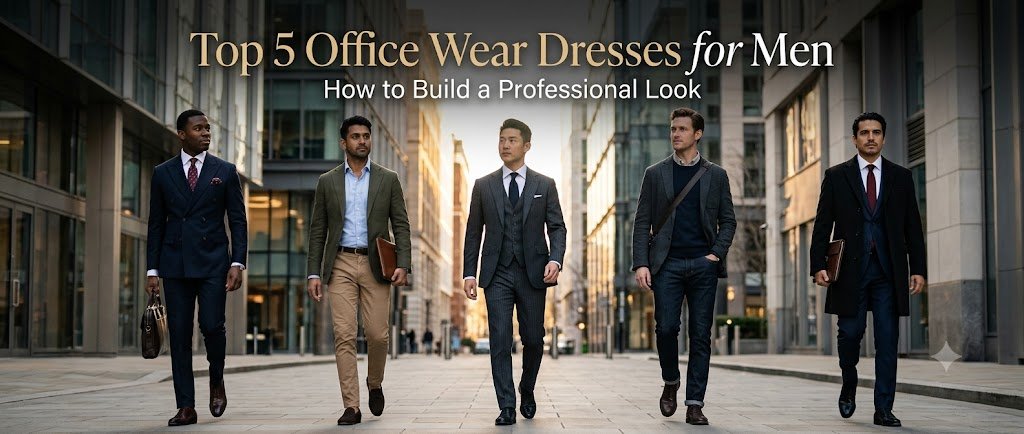
The first step in looking professional at work is not buying clothes — it is figuring out what your workplace actually expects. A formal office, a customer-facing role, a creative team and a hybrid schedule can each want something different. The five formulas below are a starting point: adjust them to your role, your comfort, your climate and whatever your company's norms are. Looking professional does not depend on expensive brands, either. Clothes that are clean, fit properly and suit the occasion do far more of that work than a label does.
1. Solid shirt and tailored trousers
A solid light or muted shirt with dark or neutral trousers is about as straightforward as formal gets. Balance white, light blue, pale grey or a muted shade you like against the trousers and the shoes. Check the shoulder seam, the collar, the sleeve and the body length. When you button it up, nothing should pull across the chest or the stomach, and the cuff should sit comfortably at the wrist.
The trousers need to sit securely at the waist without the belt doing all the work. Try the inseam and the hem on with your shoes. Choose the fabric with your commute, all those hours of sitting, and the local weather in mind. Read the ironing and washing requirements on the care label. And if you tuck your shirt in, test whether the hem stays put once you start moving.
2. Subtle pattern or textured shirt
When plain shirts start to feel like a uniform, a fine stripe, a small check or a subtle texture gives you another option. Keeping the pattern understated makes it easier to coordinate in a formal setting, though workplace norms come first. A patterned shirt sits best with plain trousers and simple shoes. If you wear a tie, look at the scale and colour of the two together before you commit.
Product photos on a screen never show colour exactly, so read the product details and the return conditions. Whether the shirt needs ironing or is easy-care is on the label. Instead of buying the same pattern over and over, look at the colours of the shirts you already own and pick the one that is genuinely missing.
3. Shirt and chinos with a blazer
In a business-casual workplace, a blazer over a neat shirt and chinos is the useful middle ground. Not every office needs one; saving it for meetings, presentations and client-facing days is the practical approach. The shoulders should sit naturally, the sleeve should not swallow the shirt cuff entirely, and the front should not strain when you button it.
Navy, charcoal or a neutral blazer is the easy one to combine with solid shirts and chinos. Match the fabric weight and the lining to the season and to the office temperature. If you plan to wear it regularly, understand the care instructions and how to store it first. For the layering basics of a professional wardrobe, the seasonal clothing guide is a useful read.
4. Knit polo or smart-casual shirt
Where the dress code is relaxed, a clean polo or knit shirt with well-fitting chinos and neat footwear works well. Look at the logo, the collar, the sleeve and the fabric finish against your office environment. A polo can be worn untucked if the hem length and the workplace norm allow it; tucked is an option too. Your comfort and the team culture both count here.
Keep a basic care routine so that lint, wrinkles and faded colour do not creep in. Smart-casual does not mean sloppy: clean shoes, a proper fit and an intact garment carry most of the impression. And if your role involves a uniform or safety equipment, the employer's required clothing comes before any fashion preference.
5. Suit or coordinated formal set
For a formal meeting, an interview or an event, a suit or a coordinated jacket-trouser set is useful — if the dress code expects it. Check the jacket's shoulders and chest, and the trouser waist and length, in a fitting room or with a tailor. Choose the colour and the level of formality to match the occasion. Keep the shirt, tie, belt and shoes coordinated; exact matching is not required.
Before you wear it out, sit, walk and move your arms in it. Add the cost of alterations, dry cleaning and storage to the purchase decision. If the suit will only come out occasionally, it is worth evaluating rental or something already in your wardrobe before buying. Both depend on your budget and on what is available locally.
How to mix and match an office wardrobe
Pick a small colour palette where the shirts, the trousers and the shoes all coordinate with one another. Weekday outfit planning gets much simpler that way. Sketch out a rough week and separate the formal combinations from the relaxed ones according to the dress code. Factor in your laundry and ironing capacity too — if a shirt has to be washed and pressed after every wear, your rotation needs to be realistic.
Hypothetical example: an employee has a formal meeting on Monday and smart-casual the rest of the week. He keeps a solid shirt-and-trouser combination for the meeting and rotates a polo or a subtle shirt with chinos on ordinary days. A blazer lives at the office for the cold meeting room. That is an example — every workplace dress code is different.
Office wear checklist
- I have confirmed the dress code and any role-specific requirements.
- Shirt shoulder, sleeve, collar and body fit checked.
- Trousers waist, length and seated comfort tested.
- Fabric care, ironing needs and weather suitability understood.
- Footwear clean and appropriate for the workplace.
- I have worn the outfit through a commute, a meeting and a full workday.
- The colours coordinate with pieces I already own.
Common mistakes
- Assuming the office rules: check with your employer or team norms.
- Judging fit while standing still: sit down in it and move your arms before deciding.
- Wearing a formal suit every day: set the level of formality by your role and the dress code.
- Forgetting the care cost: keep frequent ironing or special cleaning in the budget.
- Overdoing the accessories: start with simple, coordinated pieces.
FAQs
Is office wear always a formal shirt?
No. Depending on workplace policy, the role and customer-facing duties, formal, business-casual or relaxed styles all apply.
How do I check the size of a blazer?
Inspect the shoulders, chest, sleeve and button closure. Try it on over the shirt you would wear and move around in it.
Which colours should I choose for the office?
Choose according to your workplace and your own taste. A neutral palette is easier to coordinate, but it is not mandatory.
How should I plan clothes for hybrid work?
Consider video calls, in-person meetings, the commute and comfort separately, and follow your company's norms.
Conclusion
Build a professional look out of dress code, fit, cleanliness and comfort. Set up a reliable rotation of shirts and trousers first, then add a blazer or a suit when you will actually use it. For everyday layers, adapt the men’s seasonal outfit ideas to your commute.